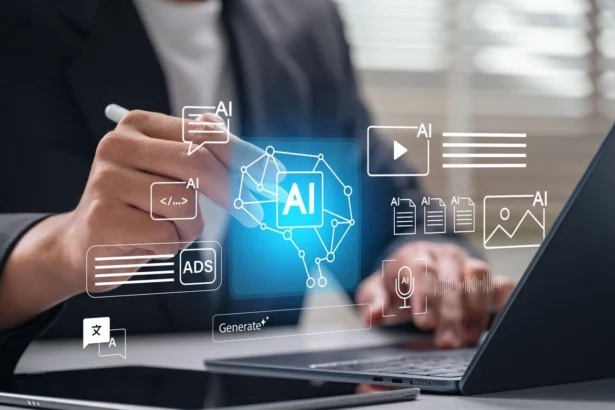



Marketing has always been driven by creativity, strategy, and an understanding of human behavior. However, in today’s hyper-connected and data-rich environment, these traditional pillars are being transformed by a powerful force—generative AI. What was once a manual, intuition-driven process is now evolving into an intelligent, adaptive system where data and creativity work together seamlessly.
- From Traditional Creativity to Intelligent Marketing Systems
- Hyper-Personalization as the New Standard
- Transforming Content Creation and Campaign Execution
- Data-Driven Decision Making and Predictive Insights
- The Balance Between Human Creativity and AI Efficiency
- Ethical Considerations in AI-Driven Marketing
- Real-World Impact Across Marketing Channels
- Looking Ahead: The Future of Marketing with Generative AI
- Conclusion
Generative AI is not just enhancing marketing; it is fundamentally redefining how brands communicate, engage, and grow. By combining machine intelligence with human creativity, it enables marketers to operate at a level of speed, precision, and personalization that was previously impossible. As businesses move further into 2025, this transformation is becoming a critical factor in staying competitive in a rapidly changing digital landscape.
From Traditional Creativity to Intelligent Marketing Systems
In the past, marketing relied heavily on human effort—brainstorming ideas, writing content, designing visuals, and testing campaigns manually. While effective, this approach was time-consuming and limited in scale. Generative AI introduces a new paradigm where creativity is no longer constrained by time or resources.
Modern tools such as ChatGPT and Midjourney act as creative partners rather than replacements. They assist marketers in generating ideas, producing content, and experimenting with different approaches in real time. This allows teams to focus more on strategy and storytelling while AI handles repetitive and data-intensive tasks.
The result is a more dynamic and responsive marketing process. Campaigns can be developed, tested, and refined at a much faster pace, enabling brands to adapt quickly to changing consumer preferences.
Hyper-Personalization as the New Standard
One of the most significant impacts of generative AI is the shift toward hyper-personalization. Traditional marketing approaches often grouped customers into broad segments, delivering similar messages to large audiences. While this method worked in the past, it lacks the precision required in today’s competitive environment.
Generative AI changes this by analyzing vast amounts of data to understand individual customer behavior, preferences, and intent. This allows marketers to create highly personalized experiences for each user.
For example, a customer browsing an online store may receive product recommendations, promotional offers, and content tailored specifically to their interests. Emails can be customized not only in content but also in timing and tone, increasing engagement and conversion rates.
This level of personalization creates a deeper connection between brands and customers. Instead of feeling like part of a mass audience, individuals experience marketing that feels relevant and meaningful.
Transforming Content Creation and Campaign Execution
Content is at the heart of marketing, and generative AI is revolutionizing how it is created and delivered. Instead of spending hours producing multiple variations of ads or posts, marketers can now generate diverse content instantly.
AI systems analyze audience behavior, trends, and engagement patterns to create content that resonates. This includes written content, visuals, videos, and even interactive experiences. Campaigns can be launched faster and optimized continuously based on real-time data.
This shift also reduces costs and improves efficiency. Marketing teams can achieve more with fewer resources, allowing them to focus on strategic initiatives rather than repetitive tasks.
At the same time, consistency across channels becomes easier to maintain. AI ensures that messaging aligns with brand identity while adapting to different platforms and audiences.
Data-Driven Decision Making and Predictive Insights
Generative AI is not limited to content creation—it also enhances decision-making. By combining analytics with predictive modeling, AI helps marketers understand what works and what doesn’t.
Instead of relying on assumptions, marketers can use data to guide their strategies. AI identifies patterns in customer behavior, predicts future trends, and recommends actions that are likely to produce the best results.
For instance, predictive analytics can determine which marketing campaigns will perform well, which audience segments are most valuable, and how customer preferences may evolve. This enables businesses to allocate resources more effectively and maximize return on investment.
In a competitive market, the ability to anticipate changes rather than react to them provides a significant advantage.
The Balance Between Human Creativity and AI Efficiency
Despite its capabilities, generative AI cannot replace human creativity. Marketing is not only about data—it is about emotion, storytelling, and connection. These elements require human insight and understanding.
The future of marketing lies in collaboration between humans and AI. While AI handles data analysis, automation, and optimization, humans focus on strategy, creativity, and ethical decision-making.
This partnership allows marketers to achieve the best of both worlds. AI provides efficiency and scalability, while human creativity ensures authenticity and emotional impact.
Organizations that embrace this balance will be better positioned to create campaigns that are both effective and meaningful.
Ethical Considerations in AI-Driven Marketing
As generative AI becomes more integrated into marketing, ethical considerations become increasingly important. Issues such as data privacy, transparency, and content authenticity must be addressed carefully.
Consumers are becoming more aware of how their data is used and how content is generated. Brands must ensure that their use of AI is responsible and transparent. This includes protecting user data, avoiding misleading content, and maintaining trust.
Ethical marketing practices are not just a regulatory requirement—they are a competitive advantage. Companies that prioritize transparency and integrity build stronger relationships with their customers.
Real-World Impact Across Marketing Channels
Generative AI is influencing every aspect of marketing, from content creation to customer engagement. It enables brands to create more targeted campaigns, improve communication, and deliver better experiences.
In content marketing, AI helps produce relevant and engaging material that aligns with audience interests. In email marketing, it enables personalized messaging that increases open rates and conversions. In advertising, it allows for real-time optimization of campaigns, ensuring better performance.
Customer support is also being transformed, with AI-powered systems providing instant and personalized assistance. This improves satisfaction and builds long-term loyalty.
The widespread adoption of AI across these areas highlights its role as a central component of modern marketing strategies.
Looking Ahead: The Future of Marketing with Generative AI
As generative AI continues to evolve, its influence on marketing will only grow stronger. Future developments are likely to include more advanced personalization, deeper integration with emerging technologies, and even greater automation.
However, success will depend on how effectively organizations integrate AI into their processes. Simply adopting new tools is not enough—companies must align technology with their goals and values.
Those that embrace innovation while maintaining a human-centered approach will lead the next phase of marketing evolution. They will be able to create experiences that are not only efficient but also engaging and emotionally resonant.
Conclusion
Generative AI is redefining modern marketing by combining intelligence, creativity, and data-driven insights. It enables marketers to move beyond traditional limitations and create campaigns that are faster, more personalized, and more effective.
However, the true potential of AI lies in how it is used. When combined with human creativity and ethical practices, it becomes a powerful tool for building meaningful connections and driving sustainable growth.
In the evolving landscape of 2025, marketing success will not be determined by technology alone, but by the ability to integrate innovation with purpose. Generative AI is not just shaping the future of marketing—it is shaping how brands and customers connect in a digital-first world.